
BROTHER FS60x
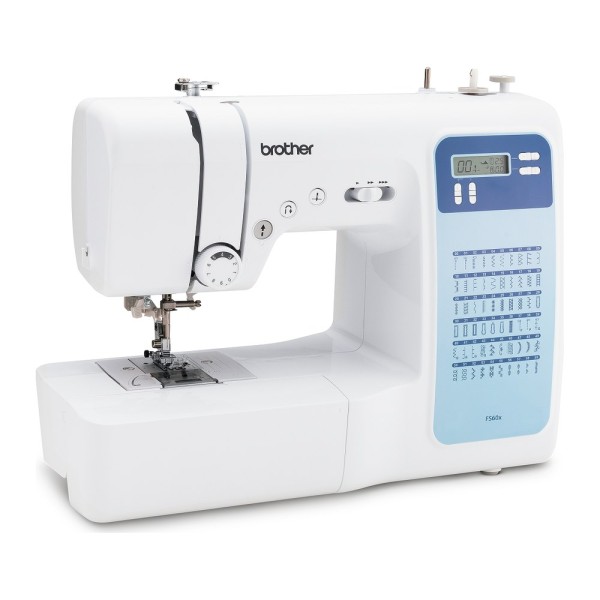

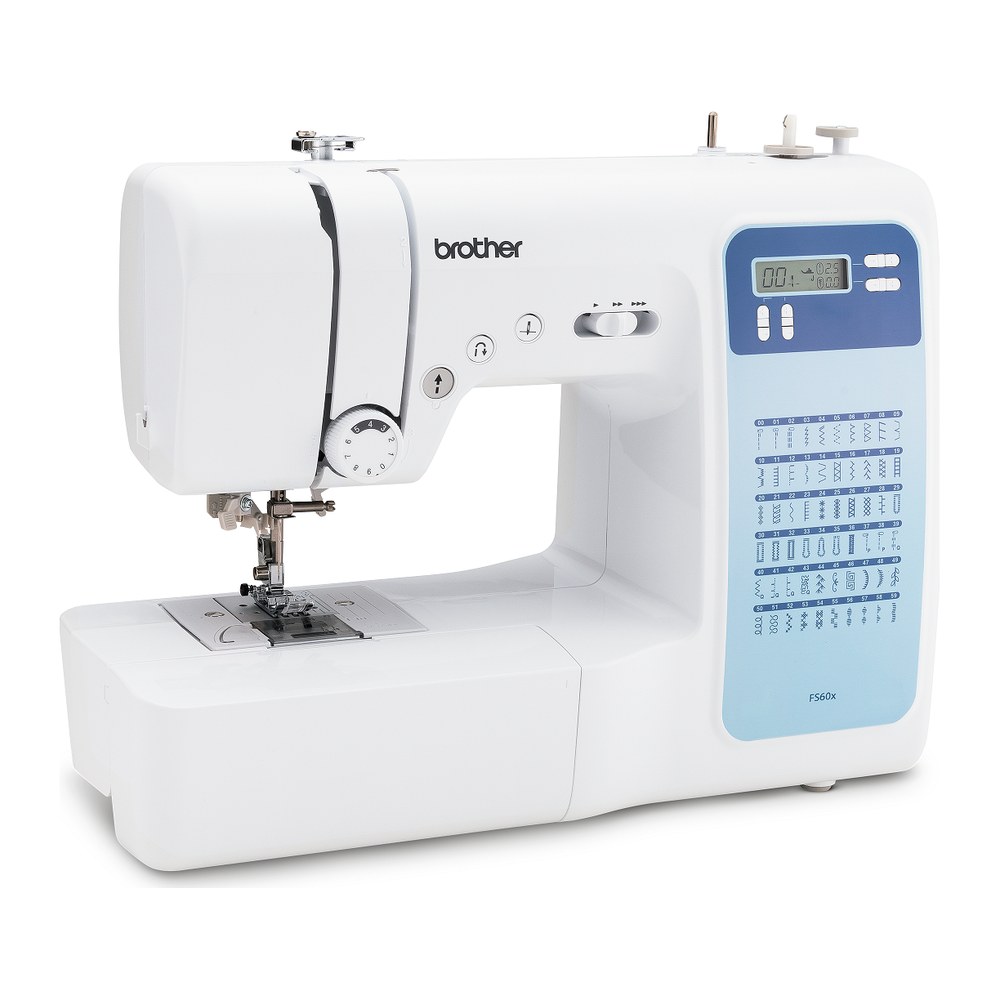
A computerised sewing machine with 60 stitches, including 7 buttonhole types. The screen shows the number of the selected stitch, stitch length and width, the presser foot to use and the single or twin needle mode. You can adjust the sewing speed with the speed slider.
You insert the bobbin from the top after opening the bobbin cover.
Remove the accessory compartment to get a free arm, onto which you can slide the item you are sewing. The compartment opens by sliding it to the left; it can hold presser feet, bobbins and needles, but put them in resealable plastic bags first so they do not fall out. The needle plate is marked with guides for sewing straight seams.
Features
60 stitches and 7 buttonhole types
The stitch selection covers utility and decorative stitches: straight and stretch stitches, zigzag, overcasting, blind hems, hemstitching, patchwork, quilting, cross and satin stitches and other decorative stitches. There is also a stitch that imitates hand quilting, as well as quilting appliqué and stippling stitches (more about them in the Stitches section).
There are 7 buttonhole types: narrow rounded and narrow squared (for light and medium-weight fabrics), stretch (for stretch and woven fabrics), heirloom (for heirloom and stretch fabrics) and three keyhole types: the standard keyhole (for heavyweight or thick fabrics and larger flat buttons), the tapered keyhole (for medium to heavy fabrics and larger flat buttons) and the keyhole with a vertical bar tack (for reinforcement in heavyweight or thick fabrics). All of them are sewn with buttonhole foot “A”. Put the button in the button guide plate of the foot to set the buttonhole length (button diameter + thickness; the maximum buttonhole length is about 28 mm). If the button does not fit in the plate, add the diameter and thickness together and set the plate to that length on the scale: for example, for a button 15 mm in diameter and 10 mm thick, set it to 25 mm. Sew a trial buttonhole on a scrap of your fabric first. For buttonholes on stretch fabrics, use an extra gimp thread. When the buttonhole is sewn, insert a pin next to one of the bar tacks and cut the fabric towards the pin with the seam ripper. Make the round hole of a keyhole buttonhole with the eyelet punch (not included in the box; place thick paper under the fabric), then open the buttonhole with the seam ripper.
LCD screen and stitch settings
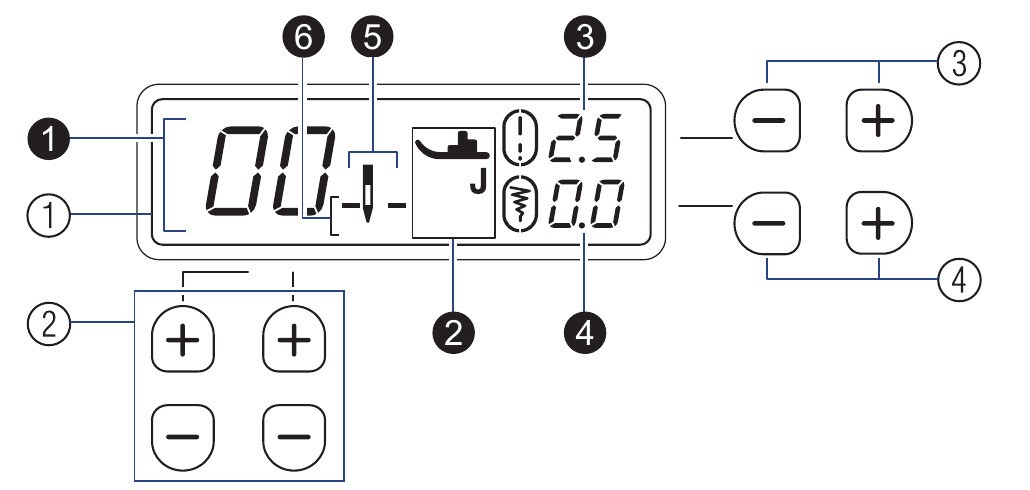
The screen shows the number of the selected stitch, the presser foot to use, stitch length and width in millimetres, the needle stop position and single or twin needle mode. You change the stitch number with two pairs of keys (one changes the tens digit, the other the ones digit), and the length and width with separate keys next to the screen. When you select a stitch, the screen shows its standard length and width, which you can change.
Stitch length can be set up to 5 mm and stitch width up to 7 mm. With a straight or triple stretch stitch selected, the width keys change the needle position: increasing the width moves the needle to the right, reducing it moves the needle to the left. The stitch numbers are printed on the machine body. In the picture: 1 – stitch number, 2 – presser foot, 3 – stitch length (mm), 4 – stitch width (mm), 5 – single / twin needle mode, 6 – needle stop position; outlined digits: 1 – LCD screen, 2 – stitch selection keys, 3 – stitch length keys, 4 – stitch width keys.
Upper thread path and needle threader
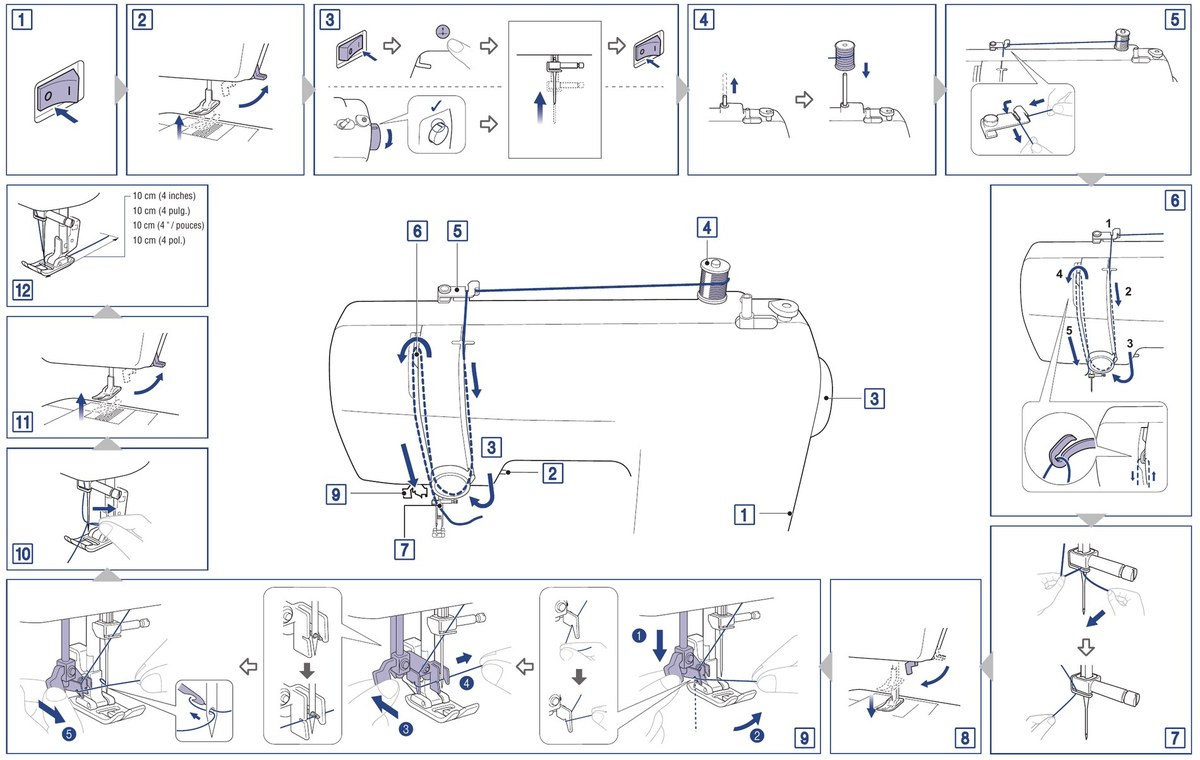
Numbers printed on the machine body show the thread path (the picture shows the 12-step thread path from the official quick reference guide). The built-in needle threader helps you thread the needle. In the figure: 4 – placing the spool on the spool pin, 9 – threading the needle with the needle threader, 12 – pulling about 10 cm of thread out towards the back under the presser foot (the caption in the figure is in several languages).
The threader can be used only with home sewing machine needles 75/11–100/16. With decorative threads or special needles (twin needle, wing needle), thread the needle by hand, with the machine switched off.
Bobbin and winding
Wind thread onto the bobbin with the built-in bobbin winder; you can adjust the winding speed with the speed slider. Brother recommends winding stretch thread, such as transparent nylon thread, at a low speed because the thread may stretch. Insert the bobbin from the top after opening the bobbin cover. The machine has a quick-set bobbin: after inserting the bobbin, feed the end of the thread through the slit and pull it to cut the thread. You can then begin sewing without drawing up the bobbin thread; draw it up when you sew gathers or want to tidy the thread ends at the start of the seam. Use only the included bobbins or bobbins of the same type: Class 15, 11.5 mm high (SFB: XA5539-151).
More features
Reverse button
- With a straight (00, 01) or zigzag (04) stitch selected, holding down the reverse/reinforcement stitch button sews backwards.
- With other stitches, pressing the button sews 3 to 5 reinforcement stitches in the same place.
- Use it to secure the start and end of a seam.
Speed slider
- The slider adjusts the sewing speed.
- It also sets the maximum speed of the foot controller and adjusts the bobbin winding speed.
“Start/Stop” button
- Press the button to start or stop sewing.
- When the foot controller is connected, this button is disabled.
Needle position button
- Press the button to raise or lower the needle; pressing it twice sews one stitch.
Handwheel
- The handwheel raises and lowers the needle by hand.
Foot controller
- Pressing the pedal harder or more lightly changes the sewing speed.
- Switch the machine off before you insert the foot controller plug.
Thread tension
- You adjust the thread tension with the dial (scale 0–9).
Thread cutter
- When you finish a seam, cut the threads with the thread cutter on the machine.
Lowering the feed dogs
- A switch at the rear of the machine, on the base, lowers the feed dogs.
- With the feed dogs lowered and button fitting foot “M” attached, you can sew on buttons.
Sewing light
- The main power switch turns on the power, the sewing light and the LCD.
Maintenance
- The user must not oil the machine: it was lubricated at the factory with the right amount of oil, so periodic oiling is not needed.
- Unplug the machine before cleaning; clean the bobbin case area with the brush and do not oil it.
- If the handwheel is hard to turn or the machine makes an unusual noise, contact a service centre.
- Do not clean the bobbin case area with compressed air.
Additional sewing settings
You change these settings by holding down the key assigned to each function while you switch the machine on with the main power switch. The settings are kept when the machine is switched off.
- Needle stop position: lowered (in the fabric) or raised
- Initial needle position when switched on (straight stitch): left or centre
- Automatic reverse / reinforcement stitching at the beginning and end of a seam: on or off
- Maximum sewing speed: standard or slower (in slower mode the maximum speed set with the speed slider is also lower)
- Single or twin needle mode. The twin needle is not included: use the twin needle made for this machine (part number X59296-121) with zigzag foot “J” and a stitch width of 5 mm or less. Thread it by hand; the needle threader cannot be used. The second spool needs the extra spool pin XG3488-001, which is not included. The twin needle can only be used with the stitches marked in the official stitch chart: 00–05, 08, 11–18, 20–22 and 55–59. If you select an unsuitable stitch, an error message appears.
Stitches
The machine's 60 stitches are numbered 00–59: 00 and 01 are straight stitches (needle at the left or in the centre), 02 is a triple stretch stitch, 03 a stem stitch, 04 a zigzag, 05 a 3-step elastic zigzag, 06–08 overcasting stitches, 09 and 10 blind hem stitches (for woven and stretch fabrics), 11–28 decorative and edge stitches (blanket, shell tuck, satin scallop, patchwork, couching, feather, fagoting, ladder, rick-rack, serpentine and hemstitching stitches), 37–43 patchwork and quilting stitches, and 44–59 decorative, cross and satin stitches.
Buttonholes are numbered 29–35, and the bar tack (for example, to reinforce a pocket opening) is no. 36. Piecing stitches 37 and 38 are for sewing with a 6.5 mm seam allowance (37 on the right, 38 on the left). The stitch that imitates hand quilting is no. 39: sew it with transparent nylon thread on top and a thread matching the quilt in the bobbin, with a tight thread tension so that the bobbin thread shows on the right side of the fabric; use a needle between 90/14 and 100/16. Numbers 40–43 are quilting appliqué and stippling stitches.
Each stitch has a presser foot assigned to it: “J” (zigzag foot) for straight stitches and most utility and decorative stitches, as well as patchwork and quilting stitches (00–05, 08, 11, 12, 14–18, 20, 21, 37–43), “G” for overcasting (06, 07), “R” for blind hem (09, 10), “N” for satin, hemstitching and other decorative stitches (13, 19, 22–28, 44–59), “A” for buttonholes and the bar tack (29–36). With overcasting foot “G” use only the stitches intended for it, otherwise the needle may hit the presser foot.
The twin needle can be used with stitches 00–05, 08, 11–18, 20–22, 55–59. Use it with zigzag foot “J” and the twin needle mode, even if the table shows another presser foot (see the “Additional sewing settings” section).
For the blind hem stitches (09, 10), the width value is not in millimetres (default value 0, setting range −3 to 3).
The names, presser feet and default stitch width and length of all stitches are listed in the table below (default values according to the official Brother stitch chart; you can change them with the keys next to the screen). Presser foot letters are given as shown in the Brother stitch chart.
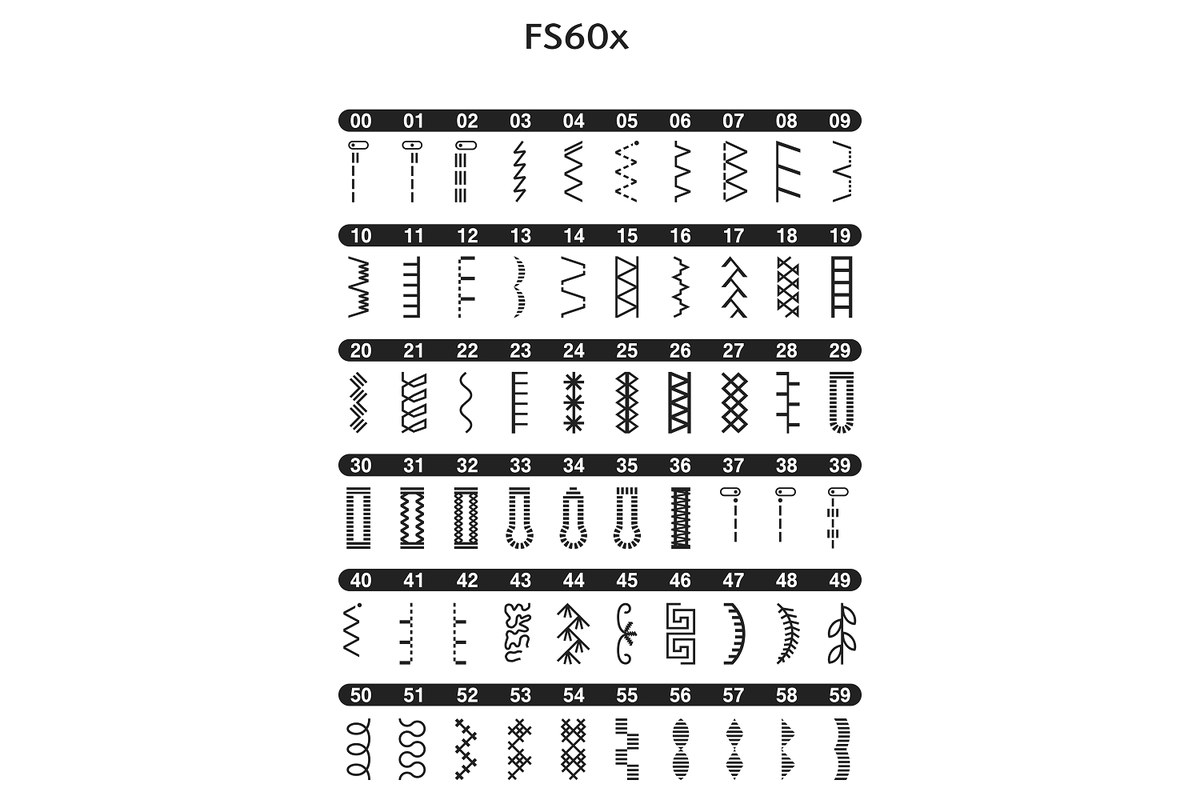
All 60 stitches
| No. | Stitch | Foot | Default width / length, mm | Twin needle |
|---|---|---|---|---|
| 00 | Straight stitch (left needle position) | J | 0.0 / 2.5 | yes (foot “J”) |
| 01 | Straight stitch (middle needle position) | J | 3.5 / 2.5 | yes (foot “J”) |
| 02 | Triple stretch stitch | J | 0.0 / 2.5 | yes (foot “J”) |
| 03 | Stem stitch | J | 1.0 / 2.5 | yes (foot “J”) |
| 04 | Zigzag stitch | J | 3.5 / 1.4 | yes (foot “J”) |
| 05 | 3-step elastic zigzag stitch | J | 5.0 / 1.0 | yes (foot “J”) |
| 06 | Overcasting stitch (light and medium weight fabrics) | G | 3.5 / 2.0 | – |
| 07 | Overcasting stitch (heavyweight fabric) | G | 5.0 / 2.5 | – |
| 08 | Overcasting stitch (reinforced seaming of stretch fabric) | J | 5.0 / 2.5 | yes (foot “J”) |
| 09 | Blind hem stitch (hemming woven fabrics) | R | 0 (not mm) / 2.0 | – |
| 10 | Blind hem stretch stitch (hemming stretch fabric) | R | 0 (not mm) / 2.0 | – |
| 11 | Blanket stitch (appliqués, decorative blanket stitch) | J | 3.5 / 2.5 | yes (foot “J”) |
| 12 | Shell tuck edge stitch | J | 4.0 / 2.5 | yes (foot “J”) |
| 13 | Satin scallop stitch (decorating blouse collars and handkerchief edges) | N | 5.0 / 0.5 | yes (foot “J”) |
| 14 | Patchwork join stitch | J | 4.0 / 1.2 | yes (foot “J”) |
| 15 | Patchwork double overlock stitch | J | 5.0 / 2.5 | yes (foot “J”) |
| 16 | Couching stitch (decorative stitching, attaching cord) | J | 5.0 / 1.2 | yes (foot “J”) |
| 17 | Feather stitch (fagoting, decorative stitching) | J | 5.0 / 2.5 | yes (foot “J”) |
| 18 | Fagoting cross stitch | J | 5.0 / 2.5 | yes (foot “J”) |
| 19 | Ladder stitch | N | 4.0 / 3.0 | – |
| 20 | Rick-rack stitch | J | 4.0 / 2.5 | yes (foot “J”) |
| 21 | Decorative stitch | J | 5.5 / 1.6 | yes (foot “J”) |
| 22 | Serpentine stitch (decorative stitching and attaching elastic) | N | 5.0 / 1.0 | yes (foot “J”) |
| 23 | Hemstitching (decorative hems, lace attaching pin stitch) | N | 3.5 / 2.5 | – |
| 24 | Hemstitching (daisy stitch) | N | 6.0 / 3.0 | – |
| 25 | Hemstitching (decorative hemming on thin, medium weight and plain weave fabrics, heirloom stitching) | N | 5.0 / 3.5 | – |
| 26 | Hemstitching (decorative hemming on thin, medium weight and plain weave fabrics, heirloom stitching) | N | 5.0 / 4.0 | – |
| 27 | Hemstitching (decorative hemming on thin, medium weight and plain weave fabrics, heirloom stitching) | N | 5.0 / 2.5 | – |
| 28 | Hemstitching (decorative hemming on thin, medium weight and plain weave fabrics, heirloom stitching) | N | 5.0 / 2.0 | – |
| 29 | Narrow rounded buttonhole stitch | A | 5.0 / 0.5 | – |
| 30 | Narrow squared buttonhole stitch | A | 5.0 / 0.5 | – |
| 31 | Stretch buttonhole stitch | A | 6.0 / 1.0 | – |
| 32 | Heirloom buttonhole stitch | A | 6.0 / 1.5 | – |
| 33 | Keyhole buttonhole stitch | A | 7.0 / 0.5 | – |
| 34 | Tapered keyhole buttonhole stitch | A | 7.0 / 0.5 | – |
| 35 | Keyhole buttonhole stitch with vertical bar tack | A | 7.0 / 0.5 | – |
| 36 | Bar tack stitch (reinforcement at a pocket opening, etc.) | A | 2.0 / 0.4 | – |
| 37 | Piecing stitch (6.5 mm seam allowance on the right) | J | 5.5 / 2.0 | – |
| 38 | Piecing stitch (6.5 mm seam allowance on the left) | J | 1.5 / 2.0 | – |
| 39 | Hand-look quilting stitch | J | 0.0 / 2.5 | – |
| 40 | Quilting appliqué zigzag stitch | J | 3.5 / 1.4 | – |
| 41 | Quilting appliqué stitch | J | 1.5 / 1.8 | – |
| 42 | Quilting appliqué stitch | J | 1.5 / 1.8 | – |
| 43 | Quilting stippling stitch | J | 7.0 / 1.6 | – |
| 44 | Decorative stitch | N | 7.0 / 2.5 | – |
| 45 | Decorative stitch | N | 7.0 / 2.0 | – |
| 46 | Decorative stitch | N | 7.0 / 2.5 | – |
| 47 | Decorative stitch | N | 7.0 / 2.0 | – |
| 48 | Decorative stitch | N | 7.0 / 2.0 | – |
| 49 | Decorative stitch | N | 7.0 / 2.5 | – |
| 50 | Decorative stitch | N | 7.0 / 1.6 | – |
| 51 | Decorative stitch | N | 7.0 / 1.4 | – |
| 52 | Cross-stitch | N | 6.0 / 2.5 | – |
| 53 | Cross-stitch | N | 6.0 / 1.4 | – |
| 54 | Cross-stitch | N | 6.0 / 1.4 | – |
| 55 | Satin stitch | N | 7.0 / 0.4 | yes (foot “J”) |
| 56 | Satin stitch | N | 7.0 / 0.4 | yes (foot “J”) |
| 57 | Satin stitch | N | 7.0 / 0.4 | yes (foot “J”) |
| 58 | Satin stitch | N | 7.0 / 0.4 | yes (foot “J”) |
| 59 | Satin stitch | N | 7.0 / 0.4 | yes (foot “J”) |
Fabrics, threads and needles
| Fabric or use | Thread | Needle | Stitch length |
|---|---|---|---|
| Lightweight fabrics (lawn, georgette, organdy, crepe, chiffon, voile, gauze, tulle, lining, etc.) | Polyester thread: No. 60–90. Cotton and silk thread: No. 50–80 | 65/9–75/11 | fine stitches, 1.8–2.5 mm |
| Medium-weight fabrics (taffeta, gabardine, flannel, linen, terry cloth, poplin, satin, quilting cotton, etc.) | Polyester thread: No. 60–90. Cotton and silk thread: No. 50–60 | 75/11–90/14 | regular stitches, 2.0–3.0 mm |
| Heavyweight fabrics (denim of 12 ounces or more, canvas, etc.) | Polyester and cotton thread: No. 30 | 100/16 | coarse stitches, 2.5–4.0 mm |
| Heavyweight fabrics (denim of 12 ounces or more, canvas, tweed, corduroy, velour, melton wool, vinyl-coated fabric, etc.) | Polyester thread: No. 60. Cotton and silk thread: No. 30–50 | 90/14–100/16 | coarse stitches, 2.5–4.0 mm |
| Stretch fabrics (jersey, tricot, T-shirt fabric, fleece, interlock, etc.) | Polyester, cotton and silk thread: No. 50 | ball point needle 75/11–90/14 | set according to the fabric thickness |
| Top-stitching | Polyester and cotton thread: No. 30 | 90/14–100/16 | set according to the fabric thickness |
| Top-stitching | Polyester and cotton thread: No. 50–60 | 75/11–90/14 | set according to the fabric thickness |
| Any fabric | transparent nylon thread | home sewing machine top-stitching needle | – |
Video
Official video about this model from Brother SewingCraft Europe.
Technical specifications
| Type | Computerised sewing machine |
|---|---|
| Number of stitches | 60, including 7 buttonhole types |
| Display | LCD |
| Stitch length | up to 5 mm |
| Stitch width | up to 7 mm |
| Adjustment ranges | Straight stitches 00 and 01 and patchwork stitches 37 and 38: stitch length 0.2–5.0 mm, width 0.0–7.0 mm; for all other stitches the length is 4.0 mm at most (the limits for each stitch are in the official stitch chart) |
| Maximum buttonhole length | about 28 mm (button diameter + thickness) |
| Twin needle | stitches 00–05, 08, 11–18, 20–22, 55–59; zigzag foot “J”, stitch width up to 5 mm; needle X59296-121 and spool pin XG3488-001 are not included in the box |
| Bobbin | quick-set, Class 15 type, 11.5 mm high (SFB: XA5539-151) |
| Needles | home sewing machine needles, sizes 65/9–100/16 |
| Recommended threads | 30–90 wt (according to the manual's table), silk 30–80 wt; thread of 20 wt or lower (heavier thread) must not be used |
| Needle threader | built in; only for home sewing machine needles 75/11–100/16; not for decorative threads, twin needles or wing needles |
| Speed control | speed slider and foot controller; the slider also sets the maximum speed of the foot controller |
| Operation buttons | “Start/Stop” (disabled when the foot controller is connected), needle position, reverse / reinforcement stitch |
| Thread tension | adjusted with a dial (scale 0–9) |
| Feed dogs | lowered with a switch at the rear of the machine (on the base) |
| Lighting | sewing light (comes on when the machine is switched on) |
| Free arm | yes (remove the accessory compartment) |
| Bobbin winder | built in (winding speed adjusted with the speed slider) |
| Presser feet in the box | 7 (J, A, G, N, I, R, M) |
| Country of origin | Vietnam |
| Intended use | Household use (according to the Brother manual) |
| Warranty | 3 years |
In the box
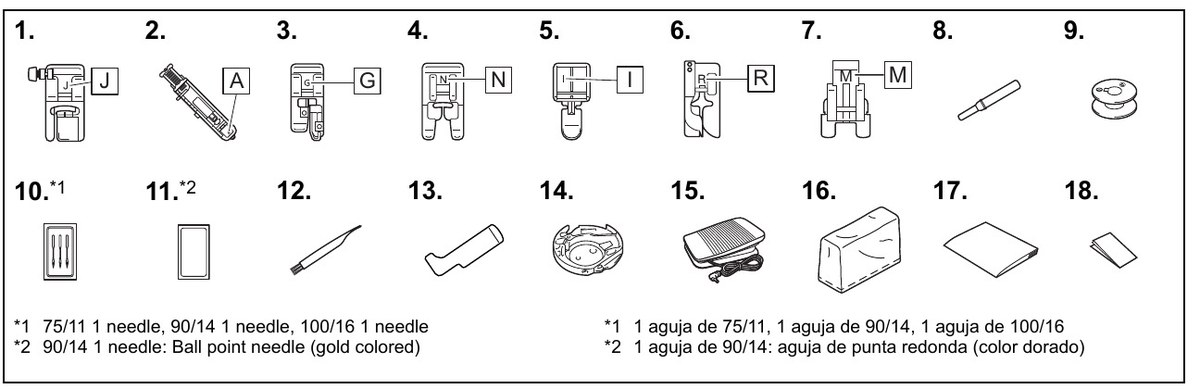
In the box, according to the official Brother included-accessories sheet. In the figure: 1 – zigzag foot “J” (on the machine), 2 – buttonhole foot “A”, 3 – overcasting foot “G”, 4 – monogramming foot “N”, 5 – zipper foot “I”, 6 – blind stitch foot “R”, 7 – button fitting foot “M”, 8 – seam ripper, 9 – bobbins (4; one inserted in the machine), 10 – needle set (*1: one each of 75/11, 90/14 and 100/16), 11 – ball point needle (*2: gold coloured, 90/14), 12 – cleaning brush, 13 – L-shaped screwdriver, 14 – bobbin case (inserted in the machine), 15 – foot controller, 16 – dust cover, 17 – operation manual, 18 – quick reference guide.
- Zigzag foot “J” (on the machine)
- Zipper foot “I”
- Buttonhole foot “A”
- Overcasting foot “G”
- Monogramming foot “N”
- Blind stitch foot “R”
- Button fitting foot “M”
- Foot controller
- L-shaped screwdriver
- Bobbins, 4 pcs (SFB; one inserted in the machine)
- Bobbin case (inserted in the machine)
- Seam ripper
- Cleaning brush
- Needle set (75/11, 90/14, 100/16)
- Ball point needle (gold coloured, 90/14)
- Dust cover
- Operation manual and quick reference guide
Optional accessories (not included in the box)
List compiled from the Brother operation manual and the Brother support page section 'Consumables & Options' for this model.
- Seam accuracy kit FP01
- Decorative edge presser foot kit FP02
- Patchwork presser foot kit FP03
- Creative Sewing Pack CSP2 (5 presser feet)
- Wide table WT17
- Bobbins and bobbin clips (BCL)
- Bobbins, 10 pcs (SFB)
- Twin needle (2/11) X59296-121
- Extra spool pin XG3488-001
- Eyelet punch XG7791-001 (for keyhole buttonholes)
- Adjustable zipper/piping foot F036N
- Blind stitch foot F017N (adjustable, for blind hems on a variety of fabrics)
- Concealed zipper foot F004N (for easy installation of concealed zippers)
- Edge joining foot F056
- Narrow hemmer foot F002N
- Non-stick foot F007N
- Picot foot F039N
- Piping foot F067
- Roller foot F066
- Side cutter F054
- Stitch guide foot F035N
- Stitch in the ditch foot F065
- Straight stitch foot F042N (needle in the centre position)
- Vertical stitching alignment foot F063
- Zigzag foot with levelling button F053
- Narrow zipper foot F079
- Concealed zipper foot F080 (for sewing in concealed zippers)
- Adjustable binder foot F071 (bias tape 5–20 mm wide)
- Binding foot F014N
- Braiding foot F021N
- Clear-view foot F023N
- Cording foot F013N (up to 3 cords)
- Cording foot, 5-hole F019N
- Cording foot, 7-hole F020N
- Fringe foot F025N
- Gathering foot F012N
- Open toe foot (metal) F060
- Open toe foot F027N
- Pearls and sequins foot F028N
- Pin tuck foot, 5 grooves F069
- Pin tuck foot, 7 grooves F058
- Bi-level feet, right and left (F081 and F082)
- 1/4-inch patchwork foot F001N
- 1/4-inch patchwork foot with guide F057
- Quilting guide F016N
- Open toe quilting foot F061
- Quilting foot F005N
- Walking foot F033N (only for straight and zigzag stitches; do not sew reverse stitches with it)
- Open toe walking foot F062
- Free motion guide grip FMG2
- Dynamic walking foot set F085
- Interchangeable toe set for dynamic walking foot F086
Manuals
- User manuals (Brother support website)Link
- Operation manual (PDF, English)PDF
- Quick reference guide (PDF, English, Spanish, French and Portuguese)PDF
- Stitch chart for 40/50/60-stitch models (PDF)PDF
- Sewing guide (PDF, English)PDF
- Included accessories (PDF)PDF
- Optional accessories (Brother support website)Link
Any questions?
Call +370 685 85915 or email info@siuvimomanija.lt. We will help you check whether this sewing machine is right for your work.