
BROTHER 2104D
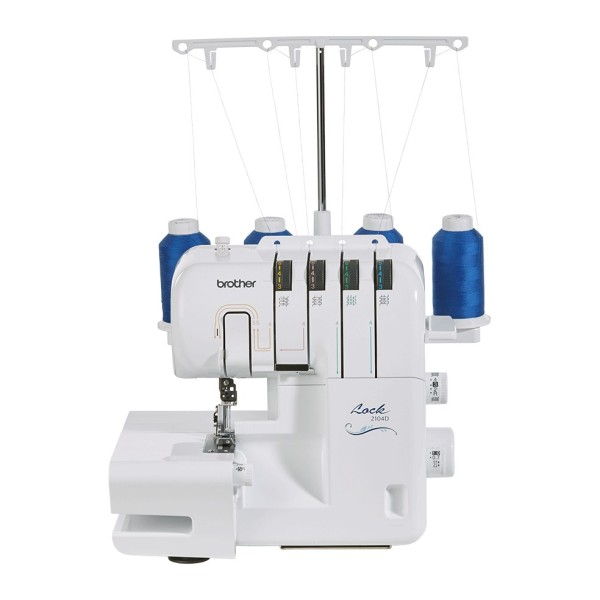

A 3- or 4-thread overlocker that sews the seam, trims the excess fabric and finishes the raw edge in one step.
The knife trims the fabric edge while the overlock stitch finishes it. Brother lists seams and hems, rolled hems and decorative effects as the uses for this model, and gives the skill level as beginner to intermediate.
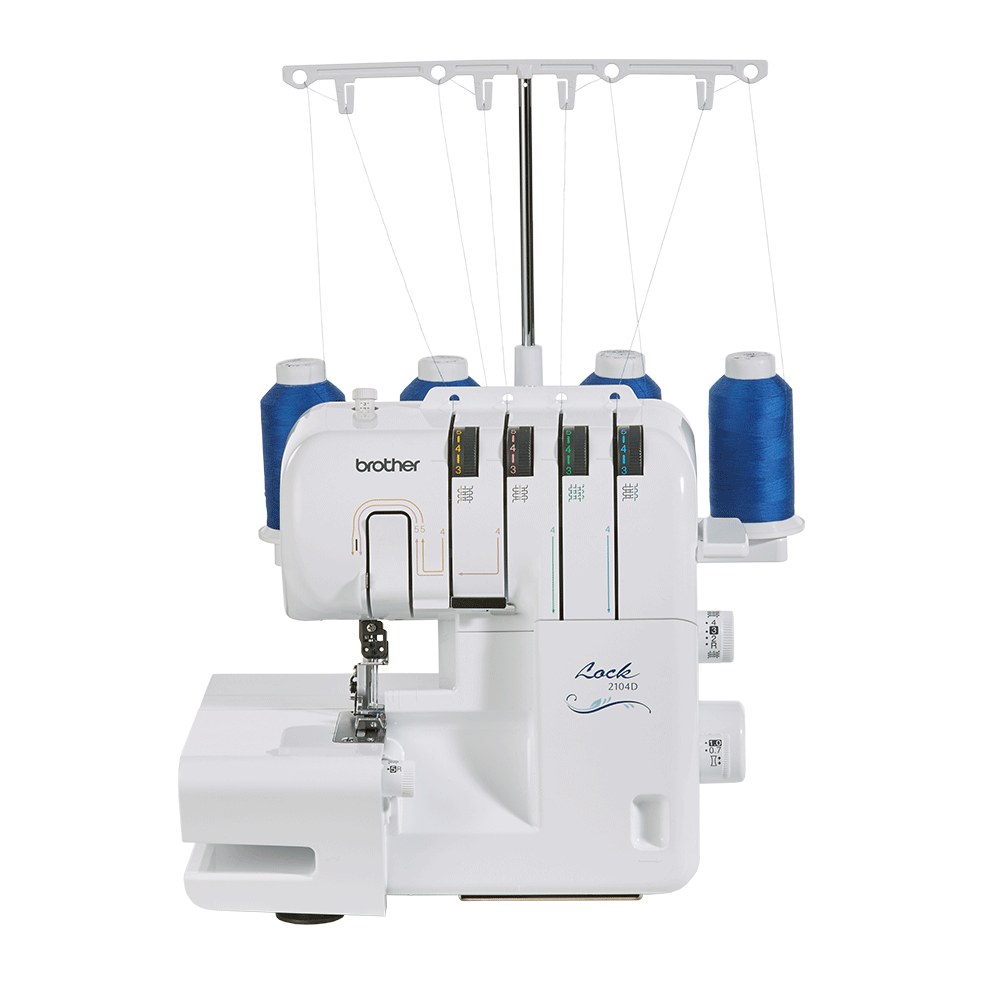
A four-colour threading guide and the F.A.S.T. lower looper threading system make threading easier. Differential feed helps avoid wavy or stretched edges on stretchy fabrics, and the free arm makes it easier to sew sleeves and cuffs.
Features
Colour-coded thread path
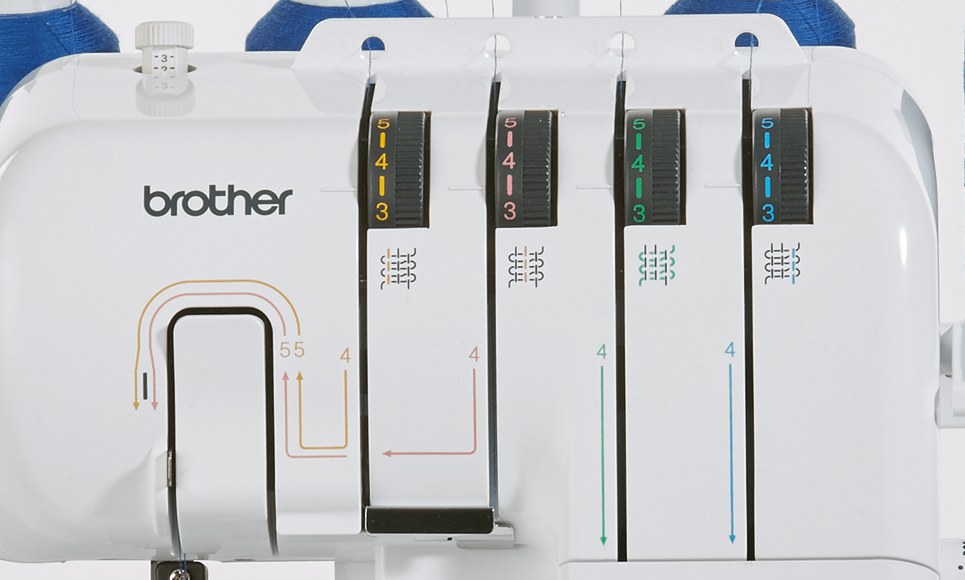
Each threading point has a colour mark and a number: the lower looper thread follows the blue marks, the upper looper the green marks, the right needle the pink marks and the left needle the yellow marks. The F.A.S.T. (Fast and Simple Lower Looper threading) system helps with threading the lower looper.
Differential feed
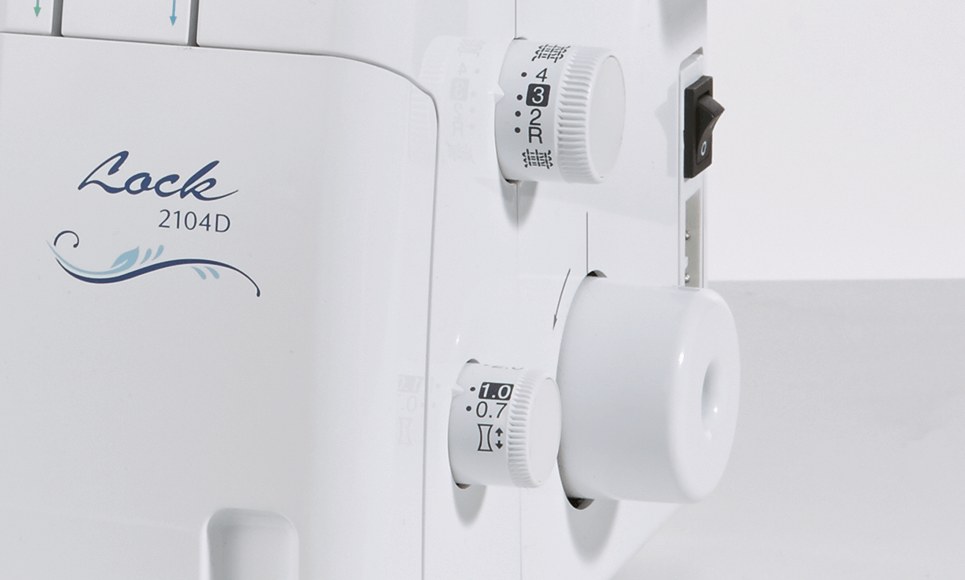
The dial at the bottom right of the machine body changes the differential feed ratio from 0.7 to 2.0. A setting of 1.0 is normal. A ratio below 1.0 stretches the fabric as it is sewn, so thin fabric does not pucker. A ratio above 1.0 gathers the fabric, so stretchy fabric does not ripple. The more elastic the fabric, the further the dial should be turned towards 2.0.
Stitch length is set with a separate dial on the right side of the body.
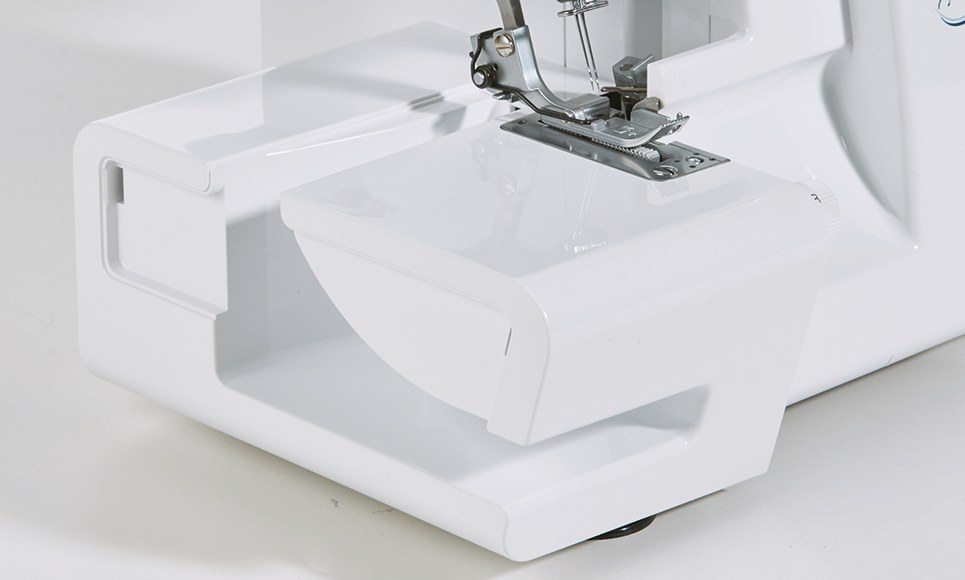
Removable bed extension
With part of the sewing bed removed, you are left with a free arm. This makes it easier to sew sleeves, cuffs and other tubular pieces.
More features
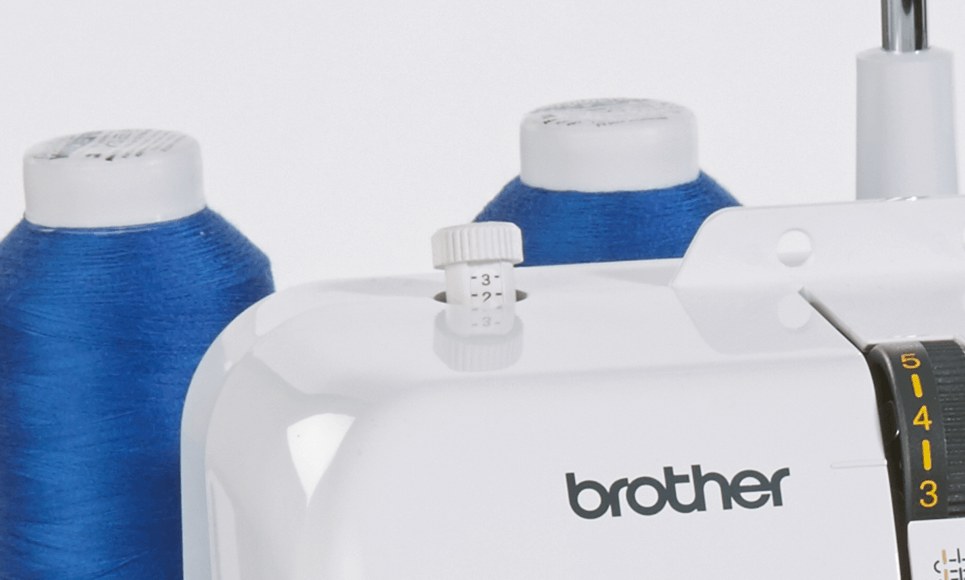
Presser foot pressure adjustment
The screw at the top left sets the presser foot pressure to suit the fabric.
The normal setting is “2”.
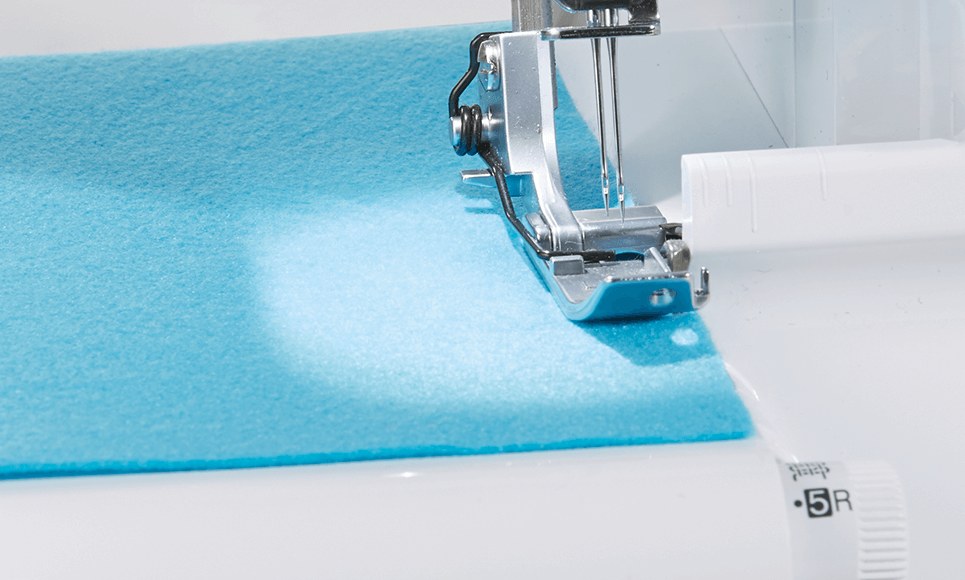
LED light
A bright LED light illuminates the sewing area.
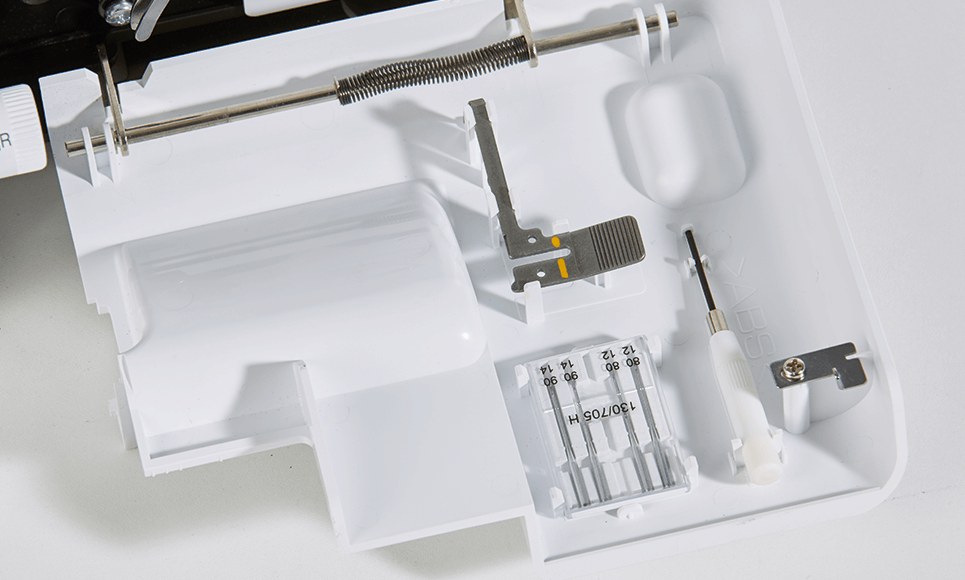
Accessory storage
The front cover compartment holds the needle set, tweezers, hex driver and the removed stitch finger.
Retractable knife
- When you do not want to trim the edge, you can retract the knife.
- Do not leave pins in the fabric while sewing: the manual warns that they can damage the needles or the knives.
Rolled hem and narrow overlock
- With the left needle and the stitch finger removed, you can sew a narrow overlock stitch and a rolled hem.
- These stitches suit lightweight to midweight fabrics.
Light and compact
- A compact, lightweight overlocker with a carry handle, easy to move.
Telescoping thread stand
- Raise the thread stand to its highest position before threading.
- Thread spool caps go on ordinary sewing thread spools, and Brother recommends covering loosely spun nylon thread with the supplied net so that it does not slip off the spool.
Stitch length and needles by fabric
- For the overlock stitch, Brother's chart suggests a stitch length of 2–3 mm and a No. 80 needle for fine fabric, 2.5–3.5 mm and a No. 80 or 90 needle for medium fabric, and 3–4 mm and a No. 90 needle for heavy fabric.
- Brother recommends putting decorative thread in the upper looper.
Trim trap (optional)
- The optional trim trap collects the trimmed fabric and thread.
- It can also be used as a foot controller holder.
Thread chain at the start and end of a seam
- An overlocker leaves a chain of threads at the start and end of a seam.
- According to the manual, when the seam is finished you let the machine run slowly so the chain forms, then cut the threads at about 5 cm.
- The chain can be secured in two ways: sew back over it and trim the rest with the knife, or pull it into the end of the seam with a large-eye hand-sewing needle and fix it with a drop of fabric glue.
Maintenance
- According to the manual, oil the machine before first use and, in normal use, once or twice a month (once a week with heavier use) after removing lint; clean dust with the included brush.
Motor and ventilation openings
- During continuous running the motor block warms up, but the manual says this does not affect performance.
- The ventilation openings on the side and rear of the machine must not be covered with paper or fabric, and lint, dust, fabric and thread ends must be cleaned off the vents and the foot controller regularly.
- While the motor runs, sparks may be visible through the vents in the motor block; the manual says they come from the carbon brushes and the commutator and are completely normal.
Changing needles
- Needles are changed with the included hex driver.
- First switch the machine off and turn the handwheel until the mark on it is aligned with the line on the machine.
- Then loosen the set screw of the corresponding needle and remove the needle.
- Hold the new needle with its flat side away from you, insert it as far as it will go and tighten the screw securely.
- If the needles are inserted correctly, the right needle sits slightly lower than the left one.
Handwheel
- The handwheel turns counterclockwise, the same direction as on an ordinary home sewing machine.
- The needles reach their highest position when the mark on the handwheel is aligned with the line on the machine.
Stitches
Brother lists the stitches below. Blind stitch, gathering, pearls and sequins, piping and taping feet and a wide table are available as optional extras.
- 4-thread overlock
- 3-thread overlock, 5 mm
- 3-thread overlock, 2.8 mm
- Narrow overlock
- Rolled hem
- Blind stitch (with optional foot)
- Flat lock (with optional foot)
- Pin tucks (with optional foot)
Video
Official video about this model from Brother My Handy Creations.
Technical specifications
| Fabrics | Light to heavy |
|---|---|
| Maximum sewing speed | 1300 stitches per minute |
| Stitch width | 5–7 mm (dial range); 2.3–7 mm in the manual's table |
| Stitch length | 2–4 mm |
| Differential feed ratio | 0.7–2.0 |
| Needle bar stroke | 25 mm |
| Presser foot lift | 5–6 mm |
| Needles | 130/705H |
| Presser foot | Standard snap-on foot |
| Threads and needles | 3 or 4 threads, one or two needles |
| Knife drive | Driven from below |
| Weight | 5.6 kg |
| Dimensions (W × D × H) | 33.5 × 28.2 × 29.6 cm |
| Intended use | Household use (according to the Brother manual) |
| Warranty | 3 years (1 year for commercial use, according to Brother) |
In the box
In the box, according to the Brother manufacturer's page and operation manual.
- Soft cover
- Accessory bag
- Needle set 130/705H (No. 80 – 2 pcs, No. 90 – 2 pcs)
- Cleaning brush
- Hex driver
- Spool nets (4 pcs)
- Thread spool caps (4 pcs)
- Tweezers
- Foot controller (with power cord)
- Instruction DVD
- Instruction manual
Optional accessories (not included in the box)
List compiled from the Brother operation manual and the Brother support page section 'Consumables & Options' for this model.
- Wide table SERGERWT2 – for better fabric handling during sewing
- Blind stitch foot SA214 – lets you sew a blind stitch and overlock the edge at the same time
- Gathering foot SA213 – designed for gathering and sewing in one operation
- Pearls and sequins foot SA211 – lets you sew a sequence of pearls onto fabric; the manual calls it the “Pearl sequence foot” and gives pearl sequences of 3–5 mm, while the Brother support page gives pearls and sequins up to 5 mm in diameter; the manual mentions decorating the edges of curtains, tablecloths and dresses
- Piping foot SA210 – lets you sew piping into the edge of the fabric; the manual mentions decorating the edges of pyjamas and sportswear, furniture covers, cushions and bags
- Tape and elastic foot SA212 – lets you attach elastic or tape in one step; the manual gives a tape or elastic width of 6–12 mm
- Trim trap – listed as an optional accessory in the manual; it holds the trimmed fabric and thread and can also be used as a foot controller holder
Manuals
Any questions?
Call +370 685 85915 or email info@siuvimomanija.lt. We will help you check whether this overlocker is right for your work.